Where this preview wave came from
In early October 2026, a dense cluster of hands-on reports about Phantom Blade Zero appeared across the games press. The trigger was a closed-door preview event that S-Game held in Beijing, to which several overseas outlets were invited; some of those same writers folded their earlier Gamescom time into the same coverage. The author at Insider Gaming reported spending close to 10 hours with the game across two back-to-back preview events, and said both sessions gave him effective free rein to explore. GameRant's writer played through the opening stretch during an extended Gamescom session, while PushSquare's reporter also played roughly six hours in Beijing.
These reports were written roughly three weeks before the October 29 release date, which is what makes them useful. Their value is not in predicting whether the game is good, but in testing claims that had previously appeared only in trailers and developer interviews against a build that actually runs. Several gameplay details recurred across the reports and were independently confirmed by multiple outlets, and those are the ones gathered here.
Boss design: frequent, varied, and mechanically distinct
Almost every writer who went hands-on singled out the boss fights as the most memorable part of the experience. Insider Gaming described one of S-Game's biggest development "struggles" as holding the team back from adding yet more bosses, and gave two concrete examples in the same paragraph: Flame, the Lion Dance Grandmaster, who spits fireballs, and the Lady of the Twin Serpents, a woman who darts around the arena on towering snakes. GameRant's writer said he faced around seven bosses in a single preview session and stressed that their movesets, visual designs, and personalities were each entirely distinct. PushSquare noted that two-phase fights already appear in the first region, and that its reporter was also jumped ahead in the campaign to meet two later opponents.
These bosses are not simply ordinary enemies with more health and higher damage. GameRant cited a boss called Jagged Steel, the Frenzied Brute, whose serrated greatsword deals heavy bleed damage if it lands consecutive hits, while a perfect parry can stop the bleed from building. The takeaway the writer drew was that the fight forced him to recognize the game asks for more than parrying alone: dodging, spacing, and combos all have to be brought into play. Only once he accepted that did the encounter turn from a wall into a rhythmic exchange of offense and defense.
A second example of the same design logic sits in the game's approach to enemy tells. Certain attacks arrive with a bright blue or red glow, and the intended response differs by color: parrying a blue-flash attack, or dodging a red-flash attack, opens up a powerful counterattack. That colour language gives each fight a readable layer on top of the timing game, and it is one of the reasons the reports describe combat as legible even at high speed.
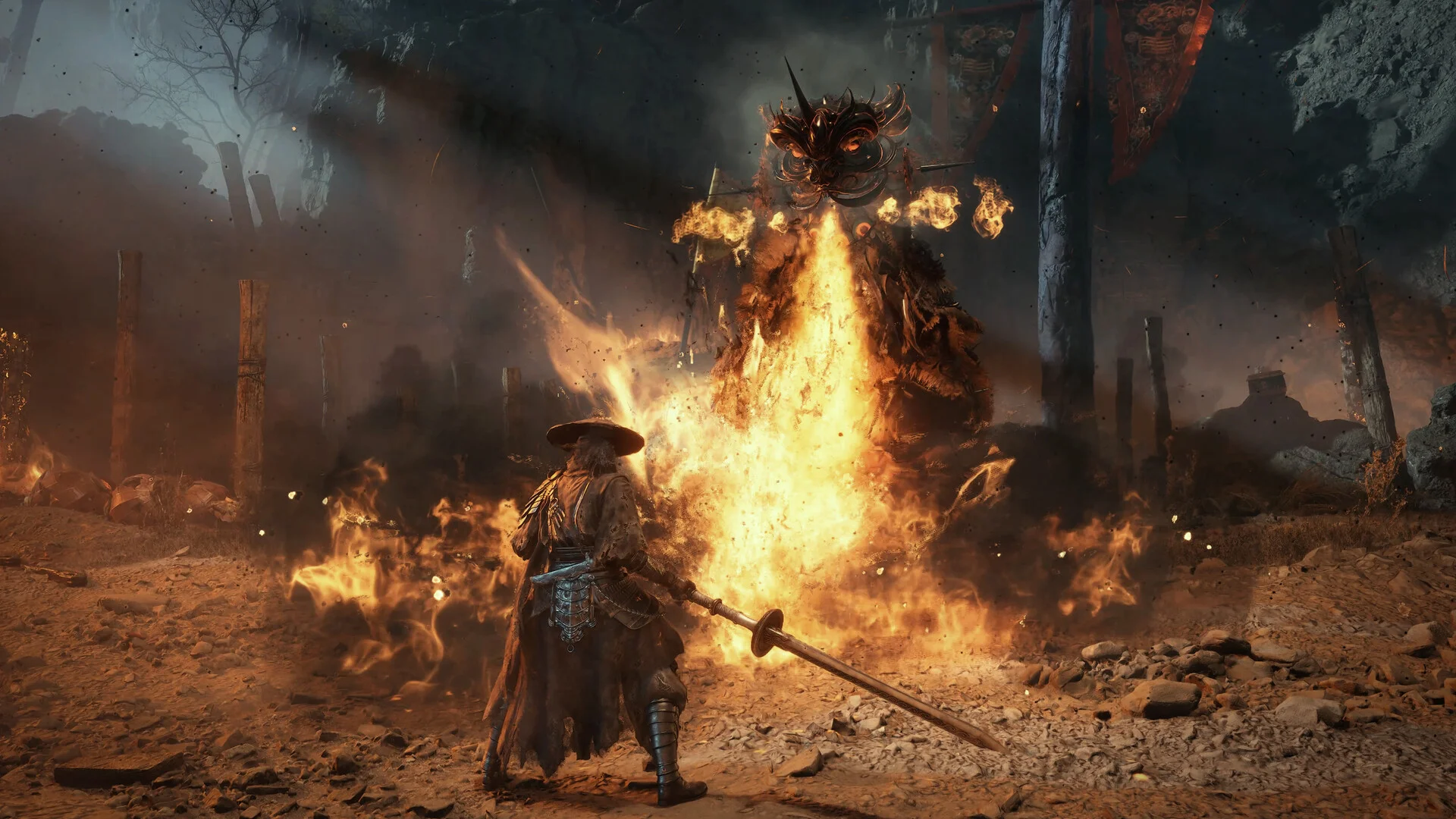
Both GameRant and Insider Gaming confirmed that bosses appear very frequently across the campaign. For players who enjoy boss fights this is welcome, but it also signals that the game does not intend to carry its runtime on a small number of showpiece encounters; instead, combat density is kept consistently high.
Taken together, those scattered observations support one more useful conclusion for players: two-phase encounters are the standard here, not a rare finale-only structure, so a demanding fight with a real learning curve can show up well before the campaign's closing stretch.
Beating a boss hands over its weapon
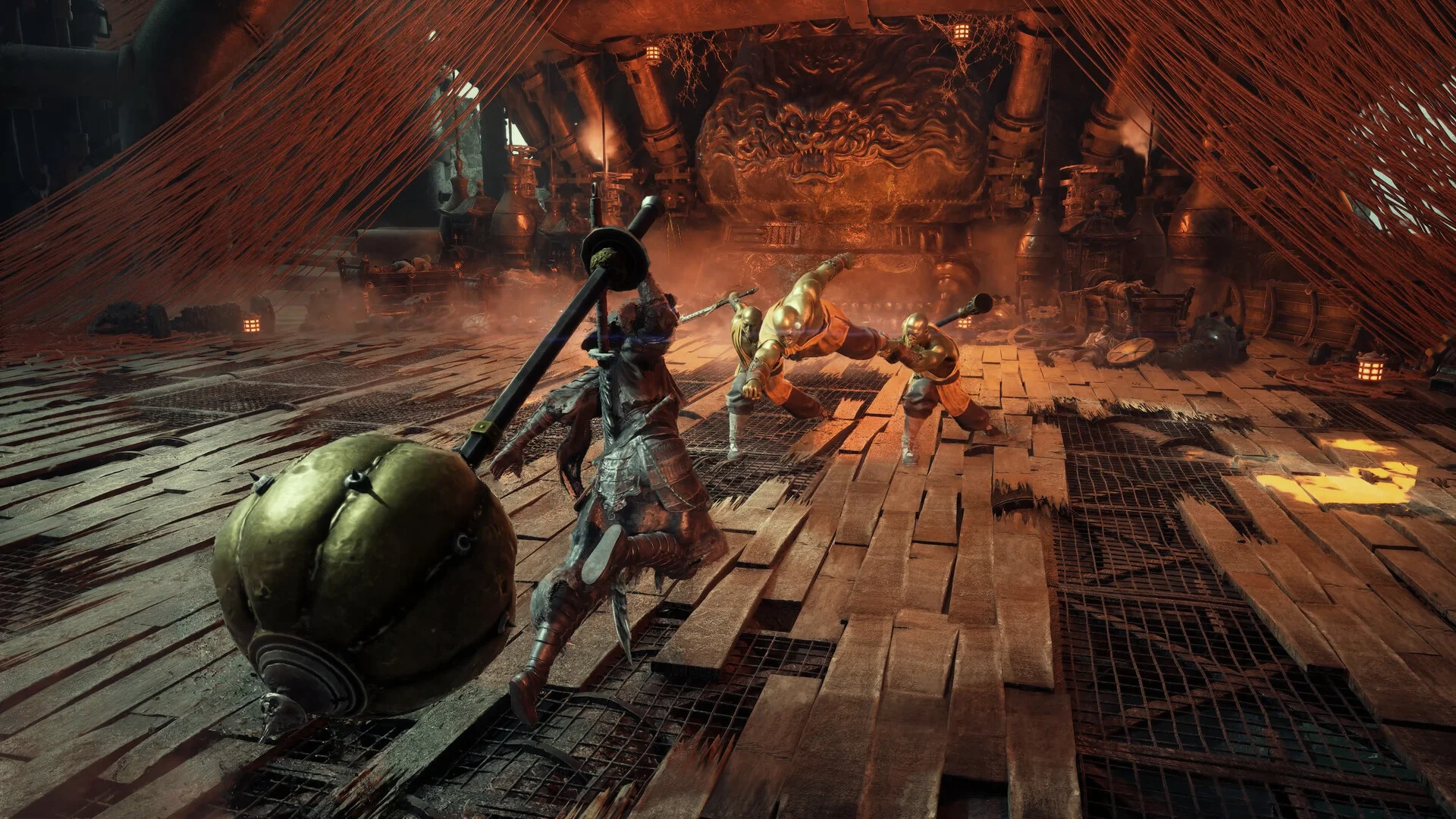
One of the most frequently repeated details from this wave, and the one most likely to shape how the game actually plays, is that defeating certain bosses grants the weapon or fighting style they were using. Insider Gaming laid out the correspondences specifically: beating the Lion Dancer awards its wearable headpiece, which lets its wearer shoot fire from the lion's mouth; taking down a drunken-fist character unlocks that same drunken style, letting protagonist Soul stagger and float through encounters. GameRant confirmed that every major boss it defeated dropped a matching weapon, and called it "the ultimate video game reward for overcoming a challenge."
This mechanic ties boss fights directly to character growth. Because each primary weapon has its own animation set, combos, and special abilities, what comes off a boss is usually not a numerically stronger version of what the player already has, but an entirely different tool with its own playstyle. That turns fighting bosses from a pure gate on progression into a route to expanding the arsenal. It is also worth noting that the reports consistently put the full game at roughly 30 primary weapons; both GameRant and Insider Gaming tried around 10 of them during their respective sessions.
The loadout itself operates on three layers rather than two. Alongside the primary weapon and the secondary Phantom Edges, Insider Gaming also noted a third slot in the form of charms. Because each weapon carries its own unique animations and moveset, the writers describe the system as one that actively invites experimentation: swapping between weapons visibly changes how an encounter plays out, rather than being a matter of trading one damage number for another.
The build layer around those weapons is deliberately loose. Insider Gaming reported that Phantom Edges function as secondary weapons that can be paired with the primary set, and that redirecting resources between different weapons is not difficult—so a player who wants to change approach is not locked into one setup. GameRant noted that weapon upgrades are a separate track from the character skill tree and that raising a weapon by five levels grants it a new combat ability, while the skill tree itself is weighted toward Soul's health, stamina, and attack power alongside a few situational perks. The two systems running in parallel mean that a weapon looted from a boss arrives with its own room to grow.
A death does not send you back to phase one
Phantom Blade Zero is often likened to Soulslike games, but this preview wave surfaced one design decision that clearly distinguishes it from them. Both the tech outlet Tech4Gamers and Insider Gaming confirmed that bosses have multiple phases, but if a player dies during the second phase, they can resume directly from that phase rather than replaying the first. Insider Gaming placed this statement right alongside the idea that the game is "not a proper Soulslike," framing it as closer to how traditional action-RPGs handle failure. Because a boss's phases are effectively separate checkpoints, a long fight is broken into shorter segments that a player can practice one at a time, rather than a single gauntlet that has to be cleared in full on every attempt.
The same philosophy extends to ordinary enemies: multiple outlets noted that defeated enemies do not respawn the way they do in a traditional Soulslike. PushSquare put it most bluntly: "you don't lose anything upon death and the enemies don't respawn." Insider Gaming's framing was that this makes clearing out an area feel more permanent, so players do not have to face the same already-solved enemies repeatedly as they push forward. S-Game had itself publicly insisted the game is not a Soulslike, and this preview wave supplied concrete mechanical evidence for that claim.
PushSquare added one further practical detail: difficulty options can be switched at any time from the pause menu. That writer said he was hit hard by jet lag partway through the preview and was stuck on a drunken boss, so he simply lowered the difficulty on the spot. In other words, hitting a wall does not require restarting a save or replaying a stretch of the campaign.
A semi-open world with a Metroidvania flavor
Outside of combat, the writers converged on how the world is structured. Insider Gaming described Phantom Blade Zero as "technically a semi-open-world game," while GameRant detailed the shape of that structure: multiple regions connected by branching paths, tied together by unlockable shortcuts, with a notable amount of vertical space to explore. The same piece explained the dual purpose of the late-game Phantom Edges—weapons that work both in combat and as tools that open previously impassable routes during exploration, which is why GameRant described the game as carrying a light Metroidvania quality.
These side paths often hold unique enemy encounters, worthwhile resources, and the occasional side quest or boss fight. Checkpoints take the form of a large bell, where players restore health and upgrade Soul's attributes through a skill tree. Weapons have their own separate upgrade system, in which raising a weapon's level by five unlocks a new combat ability.
Insider Gaming's assessment of exploration echoed GameRant but from a slightly different angle: while affirming that the boss fights are the headline attraction, the writer said he came close to fully exploring the first area during a session, and that his desire to keep exploring the world was as strong as his desire to keep fighting bosses. The two outlets used different wording, but the structural conclusion was the same—the game does not treat its world as filler between fights.
What the preview build exposed as real problems
This wave was not uniformly positive. Insider Gaming explicitly wrote that the build it played suffered from noticeable stuttering, and in a fast-paced action game that demands precise timing, even a momentary hitch can mean a missed parry and a large chunk of health lost. In the same passage, the writer attributed some of his deaths to those technical issues rather than his own inputs, while expressing confidence that S-Game would iron them out before launch, since the experience was seamless when the game ran smoothly.
GameRant, meanwhile, flagged that its preview ran on a high-end PC, and that it had no opportunity to test the game on a base PlayStation 5. That point is worth keeping in mind: most of the positive descriptions of visuals and frame rate so far come from high-spec PC environments, and the final console performance still awaits post-launch testing.
Where to go for the finer combat mechanics
For a closer look at the combat loop itself, see the site's gameplay breakdown of what kind of action game it really is; for how to build weapons and choose among the four difficulty options, the weapon and difficulty overview goes deeper.